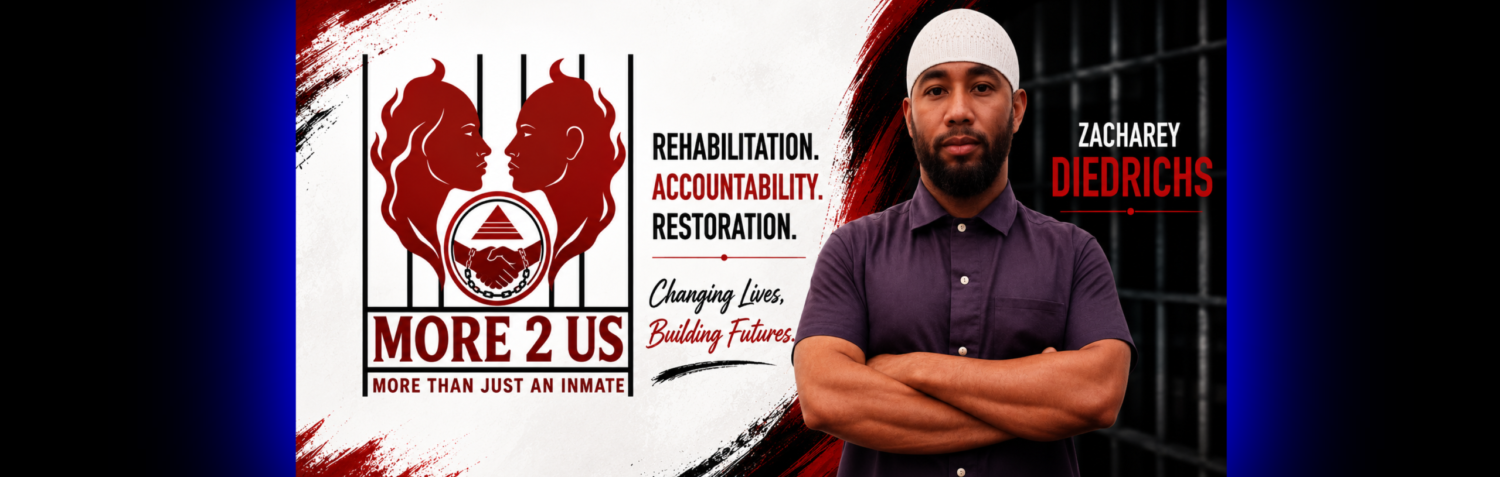

MORE 2 US was created out of lived reality, not theory.
It was built in response to a system that too often reduces people to their worst moment while ignoring their capacity for accountability, growth, and transformation. MORE 2 US exists because incarceration does not erase humanity—and rehabilitation cannot happen without structure, dignity, and real support.
At its core, MORE 2 US is an advocacy-driven organization committed to empowering incarcerated individuals and ex-cons to take responsibility for their lives while actively working toward becoming better. We believe true rehabilitation requires more than time served. It requires intention, guidance, accountability, and access to ethical pathways that reconnect people to family, purpose, and community.
MORE 2 US operates with a clear understanding of boundaries. We are not a legal service, a financial institution, or a replacement for courts, parole boards, or correctional systems. Instead, we serve as a structured support organization—designed to advocate, educate, and assist individuals and families impacted by incarceration in ways that are responsible, transparent, and compliant.
Our work is organized through defined departments that address the real gaps people face both during incarceration and after release. These include advocacy and legal awareness, rehabilitation and personal development, education and skill building, employment pathways, housing and reentry support, creative expression, participant support through a point-based recognition system, ambassador leadership, and family and community support.
One of the defining features of MORE 2 US is our Ambassador model. Ambassadors serve as the frontline representatives of the Founder and Board, working directly with inmates, ex-cons, and families. They operate in a concierge-style support role—ensuring members are treated fairly, connected to appropriate services, and supported with consistency and care. For ex-cons who are able to access our physical office, Ambassadors also function as non-clinical case workers, helping coordinate reentry services and ongoing support.
We also recognize that incarceration impacts more than the individual—it affects spouses, children, and entire households. The Family & Community Support component of MORE 2 US exists to protect children and support family stability when an incarcerated individual was the primary provider prior to incarceration. This support is carefully governed, verified, and child-centered, with strict eligibility requirements to ensure integrity and accountability.
MORE 2 US is equally committed to transparency. All donations are managed as organizational funds, and participant engagement is tracked through a non-cash Legacy Point System. This system allows us to recognize community support and participation without creating entitlement, ownership, or financial dependency. Support is always discretionary, reviewed, and aligned with our mission and compliance obligations.
Above all, MORE 2 US is rooted in respect. Respect for people who are incarcerated. Respect for families carrying unexpected burdens. Respect for communities seeking safer, healthier outcomes. And respect for the truth that rehabilitation is not about excusing harm—it is about preventing it from repeating.
We believe people can be held accountable without being discarded.
We believe systems can be challenged without chaos.
And we believe transformation is possible when structure meets compassion.
MORE 2 US exists to remind the world—and the people it serves—that there is always more to a person than a charge, a sentence, or a past chapter.
There is More 2 Us.

Supreme Council
Sets the vision and strategic direction, represents the organization, and makes final decisions on key issues.
Chief Overseer
Ly'Derian R. Greasham
Supports strategic initiatives, manages major projects, and ensures continuity in leadership.
High Chancellor
Manages staff, coordinates activities, and ensures compliance with policies and procedures.
Vice Chancellor
Tamara C. Harrison
Assists in operational management, handles special projects, and helps achieve organizational objectives.
Administrative Council
Grand Secretary
Kimberly Ross
Keeps minutes of meetings, handles communication, and maintains organizational archives.
Grand Treasurer
Darvin J. Lambert
Manages funds, prepares financial reports, and ensures financial compliance.
Grand Recorder
Valorie V. Moore
Ensures accurate documentation of organizational proceedings and decisions.
Grand Chaplain
Ifakorede Ogungbemi
Conducts ceremonies, offers counseling, and supports members’ well-being.